
| Note to Readers of A Cause Greater: Humble Governance #2: This is our second blog in a series of posts that is unpacking the concepts surrounding Humble Governance so that you can apply them in your context. As always, if you have any questions, please feel free to reach out to me or my co-author Peter A. Schein. You can find the first post here. |
What is Care for the Whole and Why does it matter?
Care for the Whole is not a new concept.
In Africa it is called Ubuntu, which carries with it the belief that I am because we are. For hundreds of years, northern Europe has called this care Bildung, while we have no singular word for it in the English language. The indigenous concept of Buen Vivir in Central and South America is based on living in harmony with Nature, others, and oneself.
For thousands of years, faith backgrounds name this as one of the greatest commandments and use the scripture verse, ‘love your neighbor as yourself’ to point us towards caring for others as a part of caring for the greater whole.
Organizations are made up of humans. Humans are created to be in harmonious relationships with each other and with nature (though our egos over the centuries repeatedly endeavor to selfishly undermine these harmonies). Nevertheless, it stands to reason that any system designed to govern, steward, or guide a human enterprise should seek to Care for the Whole.
The Humble Governance Honeycomb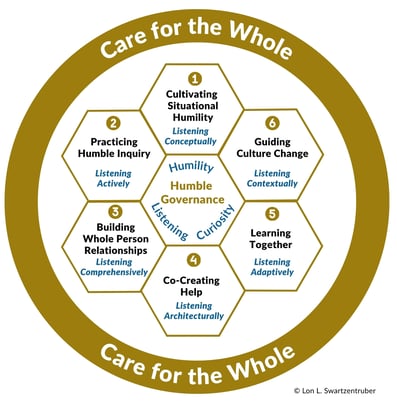
When a Humble Board cares for the whole, they regularly and constantly step back to ask and answer important questions about their behavior and the impact their organization have on the humans their mission encounters, the communities they serve, the land they inhabit, and the larger world around them.
Whether your organization uses the term customer, patient, client, student, alumni, member, guest, retreatant, etc., Humble Governance asks you to consider their best interest when making decisions in the boardroom.
If you inhabit land or leverage any lands use, Humble Governance asks you to consider the impact you have on that land, its natural resources, and in what ways are you proactively providing for its sustainability.
Simply extracting profit from the world (its humans, its land, its animals, its air & water, its life force, etc.) is not sustainable or in keeping with the concepts of Ubuntu, Bildung, Buen Vivir, or loving they neighbor. Humble Governance calls everyone to Care for the Whole.
An organization’s leadership, no matter their title or role description (board of directors, board of trustees, CEO, president, etc.) have a unique opportunity to impact our world in positive and profound ways. How they work together matters and has great influence on what happens both inside and outside of the boardroom.
Recently, I was working with a family-owned business during a time of significant transition. The long-term founding family was stepping back from ownership and considering how best to transition their company to new leadership and ownership. A complex endeavor.
During these conversations, we posed a series of questions that were borne out of a desire to Care for the Whole. Whether you are transitioning your company to new ownership, building a new research center on campus, or trying to break even for the year, open-ended questions like these can help you entertain what Care for the Whole means in your governance of the organization.
- As we consider implementing these changes, what are the long-term impacts on our employees, customers, future owners, and communities we do business with that don’t readily show up in our committee reports, financial statements, or KPIs?
- Whose voice is not present in this conversation and how might their voice help to further inform our understanding, perspective, and context for making this decision?
- What are our organization’s systems and structures that are inhibiting us from having open and trusting relationships with employees, customers, neighbors, communities, and governments around us?
- Once our products and services are delivered, in what ways do they empower or disempower those we seek to serve?
- How do we measure our interdependence with the resources we use and byproducts we produce in order to fulfill our goals as an organization?
- In what ways do the impact of our decisions create an environment for our employees and customers to live healthy lives and thrive as humans?
- In what ways is our learning shared across the organization that advances employee’s knowledge, customer’s learning of what they consume, how we together benefit humanity, and provide for a sustainable planet?
- How does the culture of our organization promote prejudices and discrimination of marginalized publics?
- What can we learn and from whom, that will position us for long term sustainability of the natural resources we consume?
- In what ways does the board actively push back against the forces of tyranny and subjugation so that its publics are positioned to thrive?
As you answer these questions (and others that emerge for you), consider how your answers further inform the development of your skills in listening, humility, and curiosity (what we call the Humble Governance Mindset.)
- In what ways do your answers give you pause?
- In what ways do your answers adjust the direction you are taking?
- In what ways do your answers reinforce something that you already know you need to work on, but have yet to comprehensively address?
A Humble Board recognizes that posing questions is essential. They also recognize that their answers, if unaddressed or acted upon, does little or no good in propelling the organization forward.
- In what ways do our answers to these questions find their way onto the board's agenda?
- What are the new discussion topics that the board needs to embrace so that we can address what we have just learned?
- What additional learnings do we need to have in order to fully understand what we are learning?
Caring for the Whole takes humility, listening, and curiosity, the application of the Humble Governance Mindset. Utilizing these skills in the boardroom requires time, presence, and the consciousness to step back and pose hard questions.
Our world, and its hyper-capitalism (what many faith backgrounds call empire) does not want boards and senior executives to behave in this way.
Our world wants us to keep the systems and structures that have been developed in place. To not question them, to keep them going, to not ask questions of them.
Humble Governance pushes back on these forces and request that we be humbler, listen deeper, and strengthen our curiosity.
If you’d like to learn more about Humble Governance and how you can apply it to your board room, please visit our website www.humblegovernance.org, or call me at 616-516-9870, or email me at lon@acausegreater.org
Mind how you go,





What are your thoughts?