
Leaders face an increasingly complex and demanding leadership environment. Uncertainty, volatility, and ambiguity come in many forms, including revenue pressure, adoption of new technology, such as AI, employee retention & wellness, shifting market & cultural expectations, long-term financial stability, and leadership transition and succession planning.
All of which competes for the time and attention of leaders and their governing boards. In these moments, it is tempting for boards to gravitate toward control, certainty, and expertise.
Introducing the Humble Governance Honeycomb
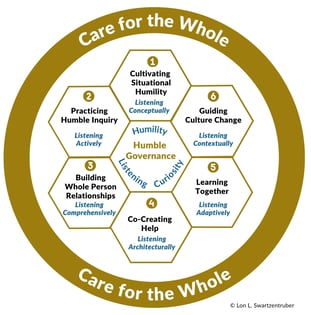
Humble Governance is defined as the practice of governing together through a dedication to building open, trusting, and resilient relationships and taking collective responsibility to care for the whole.
The six-sided hexagon is one of the strongest and most resilient shapes found in nature. Readily seen in a beehive’s honeycomb, the hexagon can support incredible weight with the least amount of surface area.
At the very center of the Humble Governance honeycomb are three interwoven human skills: humility, listening, and curiosity. (Please read this recent blog post for a deeper dive.) These skills form the Humble Governance Mindset, acting like the beeswax of the honeycomb, these ingredients form the Humble Governance honeycomb itself.
We define these skills in the following way:
Humility is recognizing and respecting other people as on par or ahead of yourself. To be humble is to intentionally focus your efforts on serving other people no less than you serve yourself.
Listening is actively attending to what someone else is saying to you. Being present in the moment to comprehensively understand the content and context of what is being shared with you.
Curiosity is the human desire to know and learn something, driving exploration, discovery, and innovation.
Humility, listening, and curiosity are skills we don’t often see in today’s world, let alone from leaders. Let’s change that!
Care for the Whole – the ultimate aim of Humble Governance
In Africa it is called Ubuntu, which carries with it the belief that I am because we are. For hundreds of years, northern Europe has called this care Bildung, while we have no singular word for it in the English language. The indigenous concept of Buen Vivir in Central and South America is based on living in harmony with Nature, others, and oneself.
For thousands of years, faith backgrounds name this as one of the greatest commandments and use the scripture verse, ‘love your neighbor as yourself’ to point us towards caring for others as a part of caring for the greater whole.
Organizations are made up of humans. Humans are created to be in harmonious relationships with each other and with nature (though our egos over the centuries repeatedly endeavor to selfishly undermine these harmonies). Nevertheless, it stands to reason that any system designed to govern, steward, or guide a human enterprise should seek to Care for the Whole.
Humble Governance draws upon the work of many thought leaders including Ed and Peter Schein [1], Amy Edmondson [2], Lene Rachel Andersen [3], Archbishop Desmond Tutu [4], Mark L. Vincent [5], and others who have spent decades studying how humans learn, lead, and collaborate. Footnoted below are their resources that helped my co-author Peter A. Schein form the concepts that make up Humble Governance. They have my thanks. Please take a look.
Rather than introducing a new governance structure, Humble Governance focuses on how boards behave regardless of the governance model they use. Traditional boards, policy governance boards, advisory boards, trustee boards, church-affiliated boards, truly all boards can benefit from its practices.
Introducing the Six Healthy Behaviors and Listening Postures of Humble Governance
Among the many reasons why the honeycomb image was chosen as a helpful metaphor for Humble Governance is because all six sides have a supportive effect on each other. Some directly, those that touch each other on their edge, and some indirectly, through the hexagon’s overall structure of interconnection.
For a Humble Board, the honeycomb’s design allows you to recognize the interconnection between each of the six healthy behaviors and listening postures. As noted in the chart below, each behavior and listening posture (the sides of the honeycomb) creates an important component of its integral strength.
This integrity can be counted on by the board, time and time again, to effectively exercise its governance responsibility and Care for the Whole. (Please read my recent post to learn more.)
While the chart below is two dimensional, consider how three dimensions further strengthen the interface of all healthy behaviors and listening postures.
|
Healthy Behavior |
Listening Posture |
Interconnection |
|
Cultivating Situational Humility |
Listening Conceptually |
Models humility, curiosity, and awareness of the unknown |
|
Practicing Humble Inquiry |
Listening Actively |
Creates and environment of listening, openness, and wonder |
|
Building Whole Person Relationships |
Listening Comprehensively |
Builds trust, cohesion, and esprit de corps |
|
Co-Creating Help |
Listening Architecturally |
Embodies the limitations of self, models the importance of others, and our mutual interdependence |
|
Learning Together |
Listening Adaptively |
Advances the larger enterprise by sharing learning so that all can benefit |
|
Evolving Culture |
Listening Contextually |
Propels our future state of being through our understanding of how to Care for the Whole |
We briefly outline these healthy behaviors and listening postures below
Healthy Behavior #1 – Cultivating Situational Humility
Situational humility [6] is the developed skill characterized by the openness to see and understand all elements of a situation by:
- Accepting uncertainty, while remaining curious to find out what is really going on,
- Being open, intentionally and mindfully, to what others may know or observe, embracing the likelihood that the group around knows more than the appointed leader or expert, and
- Recognizing when unconscious biases can distort perceptions and trigger emotional responses.
Situational humility goes beyond simply asking yourself, ‘do I want to be humble in this situation?’ Situational humility is a mindset and skill that is practiced all the time and in every situation.
When we listen conceptually to someone, we are listening with and for them, helping you understand what it is they are thinking, experiencing, and feeling. Listening conceptually draws on our natural empathy (if we allow it), to aid our understanding of them in their context.
Conceptual listening pairs well with situational humility because neither party (the listener and the person being listened to) may know precisely what is actually going on and emerging for the other person. When a Humble Board listens conceptually from a posture of situational humility, they have a fighting chance to understand what is actually going on for all of those involved in the board room.
Healthy Behavior #2 – Practicing Humble Inquiry
Edgar and Peter Schein defined the term Humble Inquiry [7] and have written widely on this leadership mindset for decades. They define Humble Inquiry as:
An Art
Humble Inquiry is the fine art of drawing someone out, of asking questions to which you do not already know the answer, of building a relationship based on curiosity and interest in another person.
An Attitude
Humble Inquiry is not just asking questions, it is a total attitude that includes listening more deeply to how others respond to our inquiry, responding empathically, and revealing more of ourselves in the relationship building process.
Our ability to humbly inquire is aided by a surprisingly powerful form of listening. When we listen actively we use our whole body to listen, signaling to the other person their importance, our undivided attention, and genuine curiosity in what they are saying.
Healthy Behavior #3 – Building Whole-Person Relationships
With the complexity of governance in our world today, boards and leadership teams must build deep, connected relationships that support the open sharing of information. Transactional relationships between people with competing agendas are a formula for conflict and failure. We refer to these constructive and helpful interpersonal connections as whole-person relationships, relationships grounded in openness, trust, and psychological safety.
Board members strengthen whole-person relationships through the practice of comprehensive listening. When we listen comprehensively, we seek to understand the full meaning of what another person is communicating. After reflecting back what we have heard, our hope is to hear, "Yes, I could not have said it better myself."
They have been seen completely and know that, at least for that moment, they are understood. This requires genuine empathy. Simply repeating someone's words is transactional listening. Comprehensive listening reflects both understanding, meaning, and human connection.
Healthy Behavior #4 – Co-Creating Help
Helping is more complex than it first appears. To be genuinely helpful, especially in the governance of an organization, we must place the other person, not ourselves, at the center of the process and co-create help with them, not for them.
This invites us to explore two connected practices: co-creating help and listening architecturally. Co-creating help means the support is shaped by the needs, context, and experience of the other person. The help belongs to them, not the helper. By practicing this behavior and posture, a Humble Board models the responsible use of authority, power, and responsibility in service of and care for the greater whole.
When we listen architecturally, we listen with the person we are trying to help. Together, we step back and examine the broader context, much like an architect reviewing a design alongside a client. This shared view and mindset helps both parties better understand their circumstances, constraints, and possibilities.
For boards and organizational leaders, this perspective is essential. Multiple priorities and competing interests are often in play in the board room. Listening architecturally helps bring those realities into view so decisions can serve the whole enterprise rather than a single agenda.
Healthy Behavior #5 – Learning together
Healthy leaders continue to learn and grow, both individually and together. For boards, this requires trust, vulnerability, and a willingness to speak honestly and receive feedback openly.
Humble Boards understand that learning happens in community. As board members share experiences, test ideas, and reflect together, they build both their individual capacity and their collective effectiveness. Learning flourishes when fear of failure is replaced by curiosity, acceptance, and trust.
Learning together is strengthened when we listen adaptively. Adaptive listening helps us look beyond our assumptions and become curious about what is happening within another person and ourselves. It reminds us that people are not fixed; they are continually growing and changing, just as we are.
When boards create psychologically safe environments where people can experiment, learn, and try again, they foster the conditions for innovation and growth throughout the organization.
Healthy Behavior #6 – Evolving Culture
We have all heard that culture eats strategy for breakfast.
So why is it that many boards see their primary role as shepherding the organization’s vision, mission, and core values by exercising their strategic plan and overseeing the CEO?
This thinking isn’t bad; it’s just not complete.
In defining culture as accumulated shared learning [8], we recognize the importance of what we have learned as an organization in our past, how that learning is impacting us (through our organization’s culture) today in our behaviors with each other, and what new learning needs to be acquired to evolve culture and remain viable as an organization.
As we consider evolving culture, we recognize that our organization’s culture has a past, a present, and a future. When we listen contextually, we listen for what is underneath, in front of, across, and beyond [9] what is being shared with us. Listening in these four dimensions aids the listener’s ability to understand how others have experienced the organization’s past culture, are experiencing the present culture, and hope to experience the desired future culture.
Creating opportunity for a Humble Board to evolve culture towards what is needed in the future.
Summary
It is our hope that through the application of these six healthy behaviors and listening postures, you will experience a more human-centered and improvement-centered approach to governance and recognize how best to care for the whole as you steward your organization.
In the coming weeks, we will publish additional blogs that go deeper into each of the six competencies and listening postures. We look forward to having you join us on this journey.
If you’d like to learn more about Humble Governance and how you can apply these behaviors and postures in your board room, please visit our website www.humblegovernance.org, or call Lon at 616-516-9870, or email him at lon@acausegreater.org
Mind how you go,

[1] Humble Leadership, Berrett-Kohler, 2023, Humble Inquiry, Berrett-Kohler, 2025, Culture Change Leadership, Wiley, 2019. All written by Edgar H. and Peter A. Schein.
[2] The Fearless Organization, Amy C. Edmondson, Wiley, 2019.
[3] Bildung, Lene Rachel Andersen, Nordic Bildung, 2020.
[4] Reconciliation, The Ubuntu Theology of Desmond Tutu, Michael Battle, Pilgrim Press, 2009.
[5] The listening postures leveraged in Humble Governance are defined and written on by Mark L. Vicent in his book Listening Helping Learning, TenthPowerPublishing, 2022.
[6] Humble Leadership, Ed and Peter Schein, Berrett-Koehler, 2023, page 8
[7] Humble Inquiry, Ed and Peter Schein, Berrett-Koehler, 2025, page 3
[8] Humble Leadership, Ed and Peter Schein, Berrett-Kohler, 2023, page 90.
[9] Listening Helping Learning, Mark L. Vincent, TenthPowerPublishing, 2022, page 51.




What are your thoughts?